Posted
Wed. Aug. 16/23

In this article: learn how to distinguish Canada lynx from bobcat, using features like ear tufts, tails, paw sizes and coat patterns. Plus, tips to safely navigate an encounter.
While walking along a trail, you might wonder what kind of wild cat left the paw prints you spot. Truth is, most of us couldn't tell the difference even if we saw the cat itself.
Western Canada is filled with incredible natural landscapes that are home to a variety of wildlife. Two of the most captivating residents are wild cats of the genus Lynx: the Canada lynx (Lynx canadensis) and the bobcat (Lynx rufus).

The differences between Canada lynx and bobcats can be hard to spot for the untrained eye. But learning what makes each cat unique can help deepen our understanding of the West’s rich biodiversity and prepare us to stay safe while exploring.
"As we continue to live, work and recreate in wildlife habitat the potential for conflict will continue to increase ... it is our responsibility to make sure that we are prepared and to expect to encounter."
- Kathy Murray, provincial support coordinator for WildSafeBC
The most stark differences between the cats come from their facial features.

"It's really the ears, they're very distinctive looking ... the black tuft at the top of each ear. That is the biggest giveaway."
- Kathy Murray, provincial support coordinator for WildSafeBC
Canada lynx’s dark-coloured tufts are very prominent. One of the most reliably consistent traits of the species is that their tufts are often longer than one inch. Bobcats' tufts are also dark but are smaller or less pronounced and sometimes even barely noticeable.
Both cats have a facial ruff that gives them a bearded appearance.

A bobcat has a short, tidy and rounded beard that looks similar to sideburns. It’s often streaked or striped and has a solid white patch under the chin. In the summer months it thins out and becomes even smaller.
A lynx has a long and shaggy beard that is highly prominent. The grey-white ruff flares out sideways with two distinct points below the chin. It remains thick throughout the year.
Canada lynx and bobcats each have unique fur and tail.

A Canada lynx has a short tail rounded by an all black tip. But a bobcat has a longer, band-patterned tail with a black tip that has white underneath.

The bobcat’s fur continues the pattern trend. It sports a reddish-brown coat with distinct black spotting that’s suited for a densely wooded environment. The Canada lynx prefers a thicker and lighter-coloured coat with minimal spots to help it blend through snowy hills.
Sign up for ZenSeekers enews for local culture & outdoor adventure across Western Canada.
Both cats differ in size and stature.

The bobcat is generally the smaller of the two cats, ranging from 50 to 125 centimetres in length and weighing from 4 to 18 kilograms. An adult stands from 1 to 2 feet tall at the shoulders. Their paw prints look similar to a house cat but are much larger at an average of 45 millimetres.

An adult Canada lynx stands near 2 feet tall at the shoulders and ranges from 70 to 110 centimetres long. They usually weigh from 5 to 17 kilograms. Canada lynx tracks are larger than those of the bobcat at 75 to 95 millimetres. Their thicker fur may make the toe pads appear less prominent.
Both Canada lynx and bobcats usually avoid humans. But knowing how to react during an encounter will help keep both you and the animal safe on the trail.
"It is pretty unusual to actually see a cougar, a lynx or bobcat. They are spot and stock hunters ... the main thing to remember is that they are predators," says Murray.
If you spot the animal from afar:
If the cat approaches or acts aggressively:
Here are some of Kathy Murray's top tips:
"We certainly encourage people to carry bear spray. Have it accessible. Know how to use it," she says. "It's no substitute for using your best common sense, but it can be a great tool."
How to use bear spray properly? Read this primer.
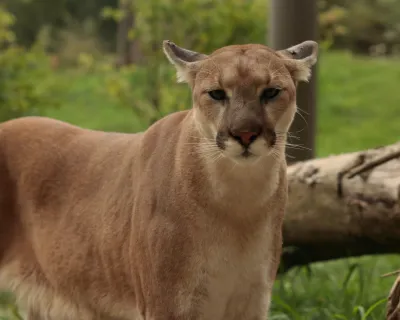
Want to learn more about western Canada's big cats? Visit WildSafeBC's page on the Cougar.
You can find more wildlife educational resources on the WildSafeBC website.
Anyone who encounters or witnesses a wildlife conflict is encouraged to report it to the Conservation Officer hotline at 1-877-952-7277.
Join the ZenSeekers newsletter to connect to more transformative experiences across Alberta and BC.