Posted
Wed. Aug. 16/23

Summary: To stay active safely during smoky conditions, check the Air Quality Health Index (AQHI). Four ways to lower exposure include: exercising in tree-dense areas, choosing non-peak periods, reducing the intensity of your exercises and traveling to nearby lower-index zones.
I went for a bike ride the other day, as the smoke blew into Edmonton. My weather app quoted an AQHI (air quality health index) of 5, but my wife quoted another source saying 10. My response was to go outside and check.
Once outside, I gathered that the smell of smoke was light, as was the cast of the sky, and breathing seemed okay. I decided to ride slowly to manage my air exchange and to take a mask with me (just in case).

It worked, but it did leave me pondering once again: how can you safely stay active outdoors, when it’s smoky?
First, check the AQHI. To summarize, the guidelines for activity and air quality according to Environment Canada are:
AQHI 1-3: low risk
Guidance: safe for everyone
AQHI 4-6: moderate risk
Guidance: generally OK but higher risk groups* should exercise caution
AQHI 7-10: high risk
Guidance: everyone should reduce or reschedule strenuous outdoor activity
AQHI > 10: very high risk
Guidance: avoid all strenuous outdoor activity
You can check air quality for your area here.
* At an AQHI of 4 or above, the elderly, children and those with sensitivities or underlying conditions (allergies, asthma, heart or lung conditions) may want to take precautions or avoid outdoor activity.

Big caveat to all of this: sometimes the Air Quality Health Index, or AQHI, is simply too high and you shouldn’t be outdoors at all if possible, much less exercising outside.
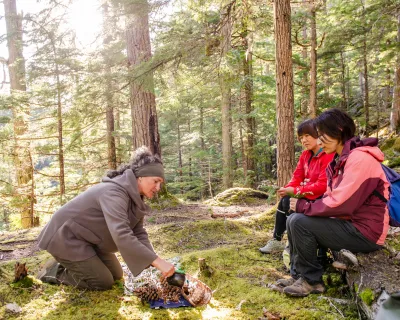
Four ways to reduce your exposure when exercising during reduced air quality periods, due to smoke, include: head to well-treed areas, choose non-peak periods, reduce intensity and travel to areas of lower risk.
One thing I noticed on my bike ride was how much fresher the air seemed in dense tree cover, along the river valley and ravines in Edmonton. That’s anecdotal, but it’s backed by science.

Usually, early morning and later evening, when there is less traffic, air quality improves as fewer vehicles are creating emissions. This helps improve air quality even if smoke is the primary source.

If the above tactics aren’t enough, you can reduce the intensity of your activities or the duration. Not ideal, obviously, but as in my bike ride example, it will help reduce the impact on your lungs.
Sign up for ZenSeekers enews for local culture & outdoor adventure across Western Canada.
At the end of the day you have to decide if the trade off to be outside, doing something active, is worth the risk based on the air quality index. Alternately, maybe this is the time to hit the climbing gym or indoor pool.
Check the air quality radar maps, and sometimes you’ll find that there are places with lower concentrations of smoke or poor air quality within two to three hours.

Of course, you need to also consider how your choice to travel impacts air quality, and whether there are any local travel advisories or evacuation alerts so you’re not in the path of escape, contributing to congestion.
But if you’re getting away from the smoke, you’re also likely getting away from wildfire threats. Just research before you go.
Typically you can check Environment Canada's Air Quality Health Index report for your area to get a forecast.
However, as ZenSeekers ambassador Tyler Dixon notes, sometimes rural areas don’t have a local forecast and rely on urban reports. For that, check Purple Air.
If you plan to travel, no judgment, but to reduce your contributions to lowering air quality, consider carbon offsets. Here’s an quick intro to how they work and why use them.
Be sure to sign up for our ZenSeekers newsletter, and check out some of these recent travel stories for your next adventure!